
Table of Contents
ToggleIf you’ve spent any time in a serious home garage or workshop, you’ve probably noticed Milwaukee tools in someone’s toolbox, and there’s a reason. Milwaukee has earned a reputation for delivering professional-grade durability and performance at prices that make sense for DIY mechanics tackling everything from routine maintenance to more ambitious engine work. Whether you’re changing oil, replacing spark plugs, or diagnosing electrical gremlins under the hood, the right tools make the difference between a frustrating afternoon and a job done right. This guide walks you through the essentials: what Milwaukee tools actually matter for automotive work, which ones deserve a spot in your collection first, and how to build your setup without very costly.
Key Takeaways
- Milwaukee automotive tools deliver professional-grade durability and performance for home mechanics, from routine maintenance to complex engine work, earning trust through build quality, ergonomic design, and reliable warranties.
- An impact driver is the single most valuable Milwaukee tool for automotive projects, offering superior torque delivery for loosening corroded bolts and fastening in tight engine bays compared to standard drills.
- Build your Milwaukee tool collection strategically starting with essentials—cordless drill, wrenches, socket set, pliers, and multimeter—which cover 80% of routine maintenance for $300–$500.
- Power tools like rotary tools, reciprocating saws, and wet/dry vacuums handle specialized automotive tasks efficiently, while hand tools including torque wrenches and locking pliers are critical for precision and safety.
- Save 20–30% on Milwaukee tools by purchasing bundles with batteries, shopping seasonal sales, and considering previous-generation models that perform identically to new releases at lower prices.
- Invest first in tools you’ll use repeatedly based on your actual project needs rather than chasing trendy equipment, and research specific projects beforehand to avoid wasteful purchases.
Why Milwaukee Tools Dominate the Automotive Workshop
Milwaukee’s appeal to home mechanics isn’t just marketing hype. The brand has built its reputation on a few core strengths that matter when you’re crawling under a car or torquing down bolts in tight engine bays.
First, build quality matters. Milwaukee tools are engineered to handle sustained use and real abuse, the kind of punishment that separates toy tools from dependable ones. A drill that can handle boring through steel or a rotary tool that spins without chattering isn’t a luxury: it’s the difference between a job that stays done and one that fails mid-project.
Second, Milwaukee invests heavily in ergonomics and user experience. Their impact drivers, for example, deliver consistent torque with less wrist strain than cheaper competitors. Their cordless systems use brushless motors, which run cooler, last longer, and deliver more consistent power than brushed alternatives. That matters over the course of dozens of projects. The company’s M18 and M12 battery ecosystems mean one charge station powers multiple tools, a huge convenience in a home garage.
Third, Milwaukee maintains strong warranties and an accessible parts network. If something fails, replacements and repairs aren’t locked behind expensive proprietary systems. For DIYers who might own these tools for years, that reliability and support structure is worth its weight.
On the purely practical side, you’ll find Milwaukee tools recommended across serious automotive forums and repair channels, not because of flashy marketing, but because mechanics who depend on tools day-in and day-out trust them. That peer validation carries weight when you’re deciding where to invest your money.
Essential Milwaukee Automotive Tools for Home Mechanics
Power Tools for Engine Work and Major Projects
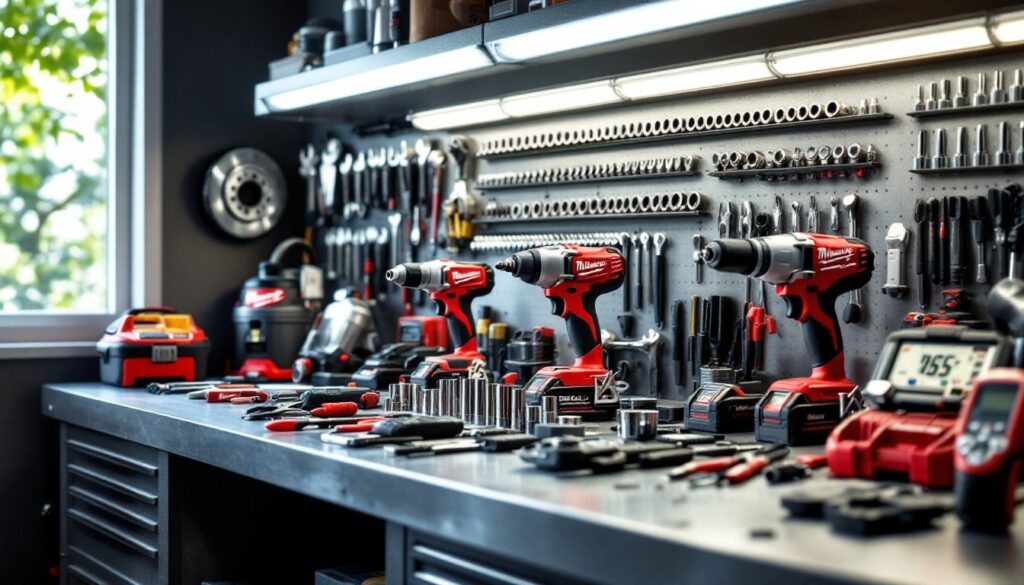
Starting with power tools makes sense: they handle the heavy lifting and save your hands. An impact driver is arguably the single most useful tool for automotive work. Unlike a standard drill, an impact driver delivers rotational force in rapid pulses, making it far superior for loosening corroded bolts or driving fasteners into tight spaces. The Milwaukee M18 FUEL Impact Driver (or the smaller M12 if you prefer lighter weight) can handle suspension work, brake jobs, and engine bay tasks without the slow speed and strain of a corded drill.
A rotary tool with variable speed is invaluable for detail work: grinding down corrosion on battery terminals, polishing chrome trim, cutting access holes, or buffing out minor surface damage. Milwaukee’s compact models accept standard bits and attachments, and the brushless versions maintain consistent speed even under load.
For anything involving fluids, oil changes, coolant flushes, brake bleeding, a wet/dry shop vacuum rated for both liquids and solids prevents spills and keeps your workspace safe. Milwaukee’s models include metal construction and durable filters rated for fine particles.
A cordless reciprocating saw cuts through exhaust pipes, rusted brackets, or damaged plastic trim without the hassle of extension cords in a garage. Variable speed lets you dial in the right pace for different materials, and recent reviews of top Milwaukee power tools consistently highlight their reliability for this task.
Hand Tools and Precision Instruments
No power tool replaces a good set of hand tools. Start with combination wrenches (inch and metric sizes from 8–19mm and ½–¾ inch) in hardened steel. Milwaukee’s versions resist rounding, which matters when you’re working on older, corroded fasteners. A socket set with a quality ratchet, especially one with a low-profile head for confined spaces, beats trying to maneuver a regular wrench in an engine bay.
A torque wrench might seem like overkill for casual work, but it’s essential for anything critical: oil drain plugs, wheel lugs, head bolts, and transmission pans. Overtightening strips threads: undertightening causes leaks or component failure. A beam-type torque wrench is affordable and accurate enough for most DIY work: Milwaukee makes reliable models in common ranges (25–250 ft-lbs is useful for most automotive tasks).
Pliers and cutters deserve care in selection. Slip-joint pliers work for many tasks, but locking pliers (Vise-Grips style) are nearly indispensable for holding stubborn fasteners, hoses, or brackets while you work. A good pair of diagonal cutters and needle-nose pliers handle wiring and brake line work. Milwaukee’s hand tools use drop-forged steel and comfortable grips that won’t fatigue your hands over a long project.
For electrical diagnostics, a multimeter is non-negotiable. Check battery voltage, test alternator output, diagnose bad grounds, you’ll use it constantly if you tackle anything beyond oil changes. Digital meters are standard now and Milwaukee’s are accurate and rugged.
A creeper or low-profile stool keeps you comfortable under the car without straining your back. Not a tool per se, but essential for longer jobs. Pair it with a good work light, LED shop lights or headlamps eliminate shadows that hide stripped fasteners and small leaks.
Building Your Milwaukee Tool Collection on a Budget
Buying everything at once isn’t realistic or necessary. Start with the tools you’ll actually use first, then expand as projects demand.
Priority tier one covers basic maintenance: a cordless drill/driver (M12 or M18), a set of combination wrenches, a socket set with ratchet, pliers, and a multimeter. These cover 80% of routine work. You can find competent Milwaukee starter kits in this category for $300–$500, depending on battery and charger inclusion.
Priority tier two arrives as you tackle bigger jobs: an impact driver (if you haven’t already), a rotary tool, and a torque wrench. Add hand-tool specialties as needed, brake adjusters, bearing pullers, or inspection mirrors. This tier runs $200–$400 more.
Priority tier three covers the occasional high-demand tool: a reciprocating saw, a drill press (for precise hole work), or specialized bits and attachments. These don’t need to be purchased all at once.
A practical budget hack: buy power-tool bundles when retailers offer them. Milwaukee frequently bundles compatible batteries with tools, which effectively discounts the individual items. Check major home improvement retailers and online suppliers for seasonal sales, Black Friday and spring/fall tool promotions can save 20–30%.
Don’t chase the newest model immediately. Previous-generation Milwaukee tools often perform identically to new ones and cost less. A two-year-old brushless impact driver works just as well today as it did at release.
Second-hand Milwaukee tools, especially hand tools, are solid buys if you inspect them carefully. Estate sales, pawn shops, and online marketplaces often have lightly used pieces. Batteries degrade, so avoid used cordless packs unless priced accordingly: buying new batteries separately is usually cheaper than a “bundled” used kit with dead packs.
Invest first in tools you’ll use repeatedly, not ones that sound cool. A rotary tool sits idle most weeks, but you’ll reach for your impact driver constantly. Honest assessment of what you’ll actually attempt saves money and keeps your garage from becoming a graveyard of unused equipment.
Resource sites like Family Handyman and Bob Vila’s guides offer tested project walkthroughs that show you exactly which tools you’ll need before you buy them. That research step prevents wasteful purchases.
Conclusion
Milwaukee tools won’t turn a novice into a master mechanic, but they’ll give you the reliable, accurate equipment that separates finished projects from frustration. Start with essentials, buy strategically, and let your project list drive your collection. A modest set of quality tools will outlast cheaper alternatives and perform reliably for years of garage work.